
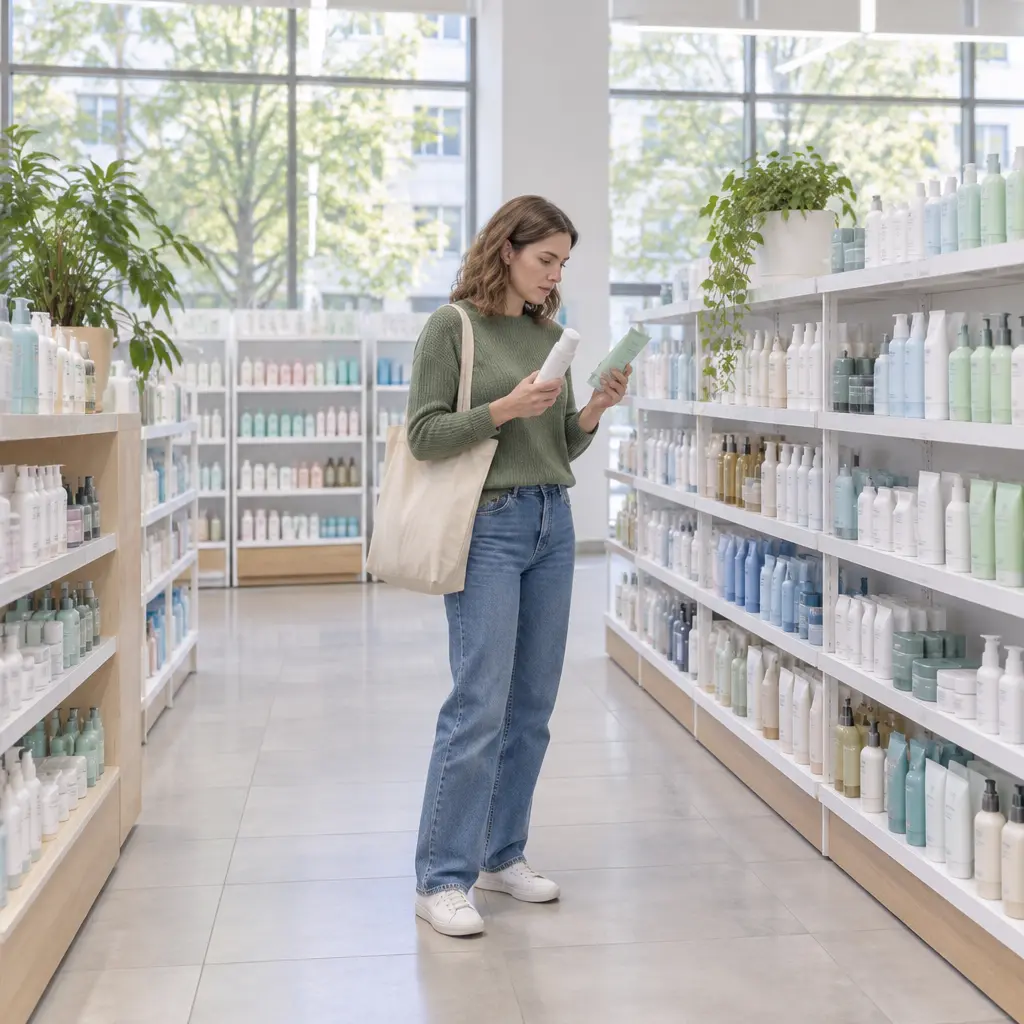
“Clean beauty” is a marketing term, not a standardized safety category, and an intimidating ingredient name does not by itself mean a product is harmful. Ingredients such as phenoxyethanol, certain sulfates, and chemical sunscreen filters can have legitimate cosmetic uses, with safety depending on factors such as concentration, exposure, and a person’s sensitivities. Understanding what these ingredients do—and what regulators and scientific reviewers actually assess—helps shoppers look beyond alarming label language while still making informed choices about fragrance, preservatives, exfoliants, and sun protection.
Ingredient safety depends on exposure, not how a name sounds
In cosmetics, an ingredient’s safety is assessed in context: its chemical properties, concentration, route and duration of exposure, and the likelihood of irritation or other effects all matter. The U.S. Food and Drug Administration (FDA) explains that cosmetic products and ingredients generally do not receive FDA premarket approval, apart from color additives, and that companies are responsible for ensuring product safety. That makes careful formulation and evidence-based review important; it does not make a frightening-sounding name proof of danger.
“Clean beauty” has no single legal or scientific definition in the United States. Brands may use it to describe products that avoid selected ingredients, but one brand’s restricted list may differ from another’s. The American Academy of Dermatology advises consumers to pay attention to their own skin reactions and notes that “natural” products can still cause allergic reactions. A useful label-reading approach is therefore to ask what an ingredient does, how much is used, and whether it suits your skin and intended use.
Preservatives: protection against contamination
Preservatives are ingredients that help limit the growth of bacteria, yeast, or mold in products that could otherwise become contaminated. The FDA notes that contamination can occur during use—for example, when fingers or water enter a container—and that contaminated cosmetics can pose health risks. A preservative may sound less appealing than a “preservative-free” claim, but leaving a water-based product unprotected can create its own safety and quality concerns.
Phenoxyethanol: a commonly used preservative
Phenoxyethanol is a preservative used in cosmetics and personal-care products. The European Commission’s Scientific Committee on Consumer Safety (SCCS) concluded that phenoxyethanol is safe as a preservative in cosmetic products at concentrations up to 1%. That conclusion applies to the stated conditions of use; it is not a guarantee that every individual will tolerate every product. People who experience a rash or irritation should stop using the product and seek medical advice if symptoms persist.
Parabens: distinguish the group from individual ingredients
Parabens are a family of preservatives, not a single substance. Scientific assessments evaluate particular members of the family and their specific uses, so broad claims that all parabens are either harmless or dangerous oversimplify the evidence. The FDA says it does not currently have information showing that parabens as used in cosmetics affect human health, while also continuing to monitor emerging research. Consumers who prefer to avoid them can do so, but the presence of a paraben on a label alone does not establish that a product is unsafe.
Preservatives are one example of why ingredient function matters. The same principle applies to cleansing agents: a sulfate’s role is to help remove oil and dirt, but the finished formula and the user’s skin or hair determine whether it feels too stripping.
Cleansers and exfoliants: strong-sounding ingredients with practical uses
Sulfates: effective cleansing agents that may not suit everyone
Sulfates such as sodium lauryl sulfate (SLS) and sodium laureth sulfate (SLES) are surfactants: they help water mix with oil and lift away soil. They are not interchangeable in every respect, and the effect of a cleanser depends on its full formula, concentration, how long it remains on the skin, and how often it is used. Dermatology guidance commonly recommends gentle, fragrance-free cleansing for people with dry or sensitive skin. Someone who finds a sulfate cleanser drying can try a milder product, while another person may tolerate it without difficulty.
Alpha hydroxy acids: exfoliation that requires sensible use
Alpha hydroxy acids (AHAs), including glycolic and lactic acid, are exfoliating ingredients used to loosen the bonds between surface skin cells. The FDA advises that AHA products may increase sensitivity to sunlight during use and for up to a week after stopping. Its consumer guidance recommends following the product directions, using sun protection, and limiting sun exposure. This is a practical example of an ingredient that can be useful when used as directed, yet calls for attention to concentration, frequency, and accompanying sun care.
A product’s purpose also changes how its risks should be judged. A rinse-off cleanser and a leave-on exfoliant create different patterns of exposure, just as a daily sunscreen has a different role from a fragrance mist. Sun-protection ingredients deserve particular scrutiny because avoiding them out of label anxiety can undermine a well-established preventive measure.
Sunscreen filters: evaluate protection and personal tolerance together
Chemical sunscreen filters: absorption is not the same as proof of harm
Chemical sunscreen filters absorb ultraviolet radiation and help reduce the amount that reaches the skin. In 2021, the FDA proposed that two filters—zinc oxide and titanium dioxide—be classified as generally recognized as safe and effective (GRASE) for use in sunscreens, while seeking additional data for several other active ingredients. The agency emphasized that requesting more information was not a conclusion that those ingredients were unsafe. The distinction matters: regulatory requests for data should not be confused with a finding of harm.
Mineral filters: an alternative, not a universal requirement
Zinc oxide and titanium dioxide are mineral sunscreen filters. They are options for people who prefer mineral formulas or find particular chemical filters irritating, but they are not automatically the best choice for every user. The American Academy of Dermatology recommends broad-spectrum sunscreen with SPF 30 or higher, alongside shade and protective clothing. The most useful sunscreen is one a person can apply adequately and regularly; texture, skin sensitivity, and intended activity can all guide the choice.
For context, the World Health Organization identifies ultraviolet radiation as a cause of skin cancer and other skin damage. Choosing sunscreen based only on whether an ingredient name sounds natural or synthetic can distract from practical protection: broad-spectrum coverage, appropriate application, and reapplication as directed.
Fragrance and individual sensitivity: when “clean” claims are not enough
Fragrance: a potential trigger for some, not a universal hazard
“Fragrance” or “parfum” on a U.S. cosmetic label can represent a blend of scent ingredients. Fragrance can cause allergic contact dermatitis in some people, but a label entry does not predict that everyone will react. The American Academy of Dermatology recommends fragrance-free products for people with sensitive skin or a history of fragrance allergy. “Unscented” is not always equivalent to fragrance-free, since a product may contain ingredients that mask odor without creating a noticeable scent.
Patch testing and a practical response to irritation
A cautious way to introduce a new leave-on product is to test a small amount on a limited area of skin and watch for a reaction, following advice from a dermatologist when there is a history of allergy or skin disease. Patch testing at home is not a substitute for medical allergy testing, and it cannot guarantee that a product will never cause a reaction. If burning, swelling, a persistent rash, or other concerning symptoms develop, stop using the product and consult a health professional.
The broader lesson is that “clean” and “toxic” are often too blunt to guide an individual decision. Ingredient function, credible safety assessments, product directions, and personal history provide a more useful basis for choosing cosmetics.
How to read a cosmetic label without being misled by scary names
- Identify the ingredient’s job: for example, preservation, cleansing, exfoliation, fragrance, or sun protection.
- Look for the conditions of use and the relevant authority’s conclusion, rather than treating a hazard headline or a request for more data as a final verdict.
- Consider exposure: whether the product is rinsed off or left on, how often it is applied, and whether the label gives use instructions or warnings.
- Account for your own history, including eczema, fragrance allergy, acne treatments, or previous reactions.
- Do not assume “natural,” “chemical-free,” or “clean” means risk-free; these claims do not replace a product-specific safety assessment.
A simple chart could compare ingredient function, common concern, and evidence-based context: phenoxyethanol—preservation, assessed safe by the SCCS up to 1%; sulfates—cleansing, potentially drying for some users; AHAs—exfoliation, with a sunlight-sensitivity precaution; and sunscreen filters—UV protection, with regulatory review differing by ingredient. Such a comparison would show why function and use conditions are more informative than how a name sounds.
Conclusion: judge cosmetic ingredients by evidence and use
Preservatives, sulfates, exfoliating acids, sunscreen filters, and fragrance can all sound concerning when considered without context. Their roles and evidence differ: preservatives help prevent contamination, surfactants cleanse, AHAs exfoliate with sun-care precautions, and sunscreen filters help protect against ultraviolet exposure. No ingredient is right for every person, but neither does an unfamiliar or technical name prove that a product is dangerous.
Read labels for function and directions, consult reputable sources such as the FDA, SCCS, and dermatology organizations, and choose products that suit your skin and routine. If a product causes a persistent reaction, stop using it and ask a qualified clinician. For further reading, review the FDA’s cosmetics and sunscreen guidance and the American Academy of Dermatology’s advice on sensitive skin and sun protection.
Sources: U.S. Food and Drug Administration, Cosmetics: Overview, https://www.fda.gov/cosmetics/cosmetics-laws-regulations/cosmetics-overview; U.S. Food and Drug Administration, Microbiological Safety and Cosmetics, https://www.fda.gov/cosmetics/potential-contaminants-cosmetics/microbiological-safety-and-cosmetics; European Commission Scientific Committee on Consumer Safety, Opinion on Phenoxyethanol, https://health.ec.europa.eu/system/files/2016-11/sccs_o_195.pdf; U.S. Food and Drug Administration, Parabens in Cosmetics, https://www.fda.gov/cosmetics/cosmetic-ingredients/parabens-cosmetics; U.S. Food and Drug Administration, Alpha Hydroxy Acids, https://www.fda.gov/cosmetics/cosmetic-ingredients/alpha-hydroxy-acids; U.S. Food and Drug Administration, FDA’s Proposed Deemed Final Order and Proposed Order for Sunscreen Drug Products, https://www.fda.gov/drugs/news-events-human-drugs/fda-proposes-updated-requirements-certain-over-counter-sunscreen-products; American Academy of Dermatology, How to Select a Sunscreen, https://www.aad.org/public/everyday-care/sun-protection/shade-clothing-sunscreen/how-to-select-sunscreen; World Health Organization, Ultraviolet Radiation, https://www.who.int/news-room/fact-sheets/detail/ultraviolet-radiation; American Academy of Dermatology, How to Test Skin Care Products, https://www.aad.org/public/everyday-care/skin-care-secrets/routine/test-skin-care-products