
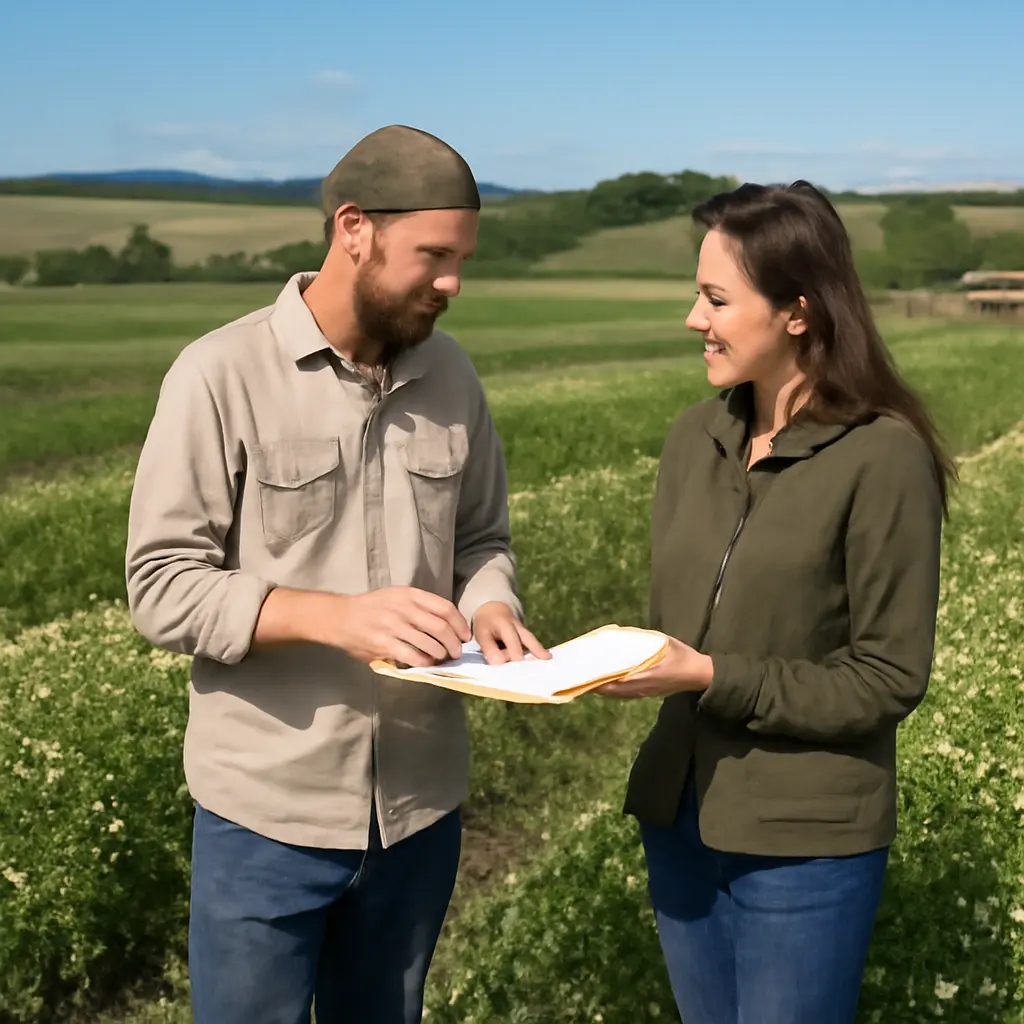
Small cosmetic brands build lasting relationships with organic growers by treating sourcing as a long-term partnership rather than a series of ingredient purchases. That means agreeing on fair, transparent terms; planning for harvest and climate risks together; supporting credible organic practices; and tracing ingredients from farm to finished product. The case for doing so is practical as well as ethical: the Research Institute of Organic Agriculture and IFOAM report that global organic farmland reached 96.4 million hectares in 2022, while the U.S. Department of Agriculture’s 2022 Census of Agriculture counted 17,445 certified-organic farms in the United States. Those figures show the scale of the supply base—and the importance of dependable relationships within it.
Long-term sourcing defines small cosmetic brand–grower relationships
A small cosmetic brand–grower relationship is an ongoing commercial and operational partnership through which a brand buys agricultural ingredients, such as oils, botanicals, waxes, or extracts, from growers using organic production methods. There is no single universal legal definition of a “lasting relationship.” In practice, it means repeated purchasing, clear expectations, fair risk-sharing, and communication that continues between harvests—not simply a one-time transaction.
Organic certification is one important part of that relationship, but it is not a substitute for good purchasing practices. The USDA National Organic Program sets production, handling, and labeling requirements for products marketed as organic in the United States. For cosmetics, the applicable requirements depend on the product and its ingredients; a brand should not assume that an “organic” claim is automatically authorized just because a supplier uses organic farming methods. The U.S. Food and Drug Administration notes that cosmetics marketed with organic claims must still comply with relevant FDA requirements, while USDA organic rules apply when products or ingredients fall within the program’s scope.
Repeated orders and forward planning
A repeat-order partnership is a purchasing arrangement in which a brand gives a grower reasonable visibility into expected demand and places recurring orders where quality and market conditions allow. Forecasts do not need to be perfect: even a seasonal estimate, a likely order window, and prompt notice of changes can help growers plan land, labor, seed, and post-harvest processing. Brands should distinguish a forecast from a guaranteed purchase, then state clearly which quantities are binding.
This planning matters because botanical supply depends on harvest timing and environmental conditions. The Food and Agriculture Organization’s climate-risk work documents how changing weather patterns can affect agricultural production and livelihoods. For cosmetic brands, the practical implication is to avoid building a formula around a single fragile source without discussing crop variability, lead times, and alternative lots with the grower.
Fair contracts and shared risk
A fair sourcing contract makes price, quality specifications, delivery windows, payment timing, rejection procedures, and exceptional circumstances understandable to both parties. It should identify how the parties will handle a short harvest, a delayed shipment, a change in moisture or active-compound levels, or a quality dispute. Small brands can negotiate simpler agreements than large corporations, but simplicity should not mean leaving key risks undefined.
Payment speed is especially consequential for smaller farms that must cover labor and harvest costs before receiving proceeds. Brands can support stability by paying deposits when appropriate, meeting agreed payment deadlines, and avoiding retroactive changes to specifications. Where a brand seeks a premium for organic, regenerative, or carefully harvested material, it should explain how that premium is calculated rather than relying on a vague ethical claim.
Trust grows through verification, communication, and traceability
Trust in a cosmetic supply relationship is the confidence that both parties will meet agreed standards and share relevant information in good faith. It is built through reliable conduct and verifiable records: certification documents, lot identification, test results, transparent pricing discussions, and timely notice when conditions change. Certification verifies compliance with a defined standard; it does not, by itself, prove that a grower receives a fair price or that every sustainability claim is accurate.
Organic documentation and ingredient integrity
Organic documentation is the set of records used to establish a material’s identity, certified status where applicable, and chain of custody. Brands should request current certificates from the appropriate certifier, confirm that the named operation and product scope match the purchase, and retain transaction and lot records. The USDA National Organic Program’s rules require certification for many operations that produce or handle products sold as organic, subject to specified exemptions and conditions.
Cosmetic quality documentation should be agreed alongside organic paperwork. Depending on the ingredient, this may include botanical identity, country and harvest information, processing method, allergen or contaminant data, and a certificate of analysis. The European Commission’s guidance on cosmetic product safety emphasizes the need for a product information file and safety assessment for cosmetics placed on the EU market. A brand selling internationally should therefore align supplier documentation with the regulatory requirements of each market, rather than treating an organic certificate as a complete safety dossier.
Traceability from farm lot to finished product
Traceability is the ability to follow an ingredient through the stages of production, processing, storage, and use in a finished product. A practical system links the grower or producer, harvest or production lot, processor, shipment, incoming inspection, and cosmetic batch. For a small brand, a well-maintained spreadsheet and orderly document storage may be sufficient at first; the essential feature is that records can be retrieved and reconciled.
Traceability protects both partners. If an ingredient fails a specification, a brand can isolate the affected lot instead of rejecting unrelated material, while a grower can help identify where a variation arose. The U.S. Food and Drug Administration’s cosmetics rules, including requirements introduced under the Modernization of Cosmetics Regulation Act of 2022, have increased the importance of dependable product and facility records for many businesses. Brands should confirm their specific obligations with qualified regulatory counsel or the relevant authority.
Direct, cooperative, and processor-mediated sourcing
Direct sourcing means a brand buys from a grower without a conventional intermediary; cooperative sourcing means growers pool supply, services, or negotiating power; and processor-mediated sourcing uses a distiller, mill, or ingredient supplier between farm and brand. These are complementary models, not a hierarchy. Direct buying can deepen communication, but it may increase the brand’s workload. Cooperatives can aggregate volume and strengthen small producers’ market access. Processors can provide extraction, testing, storage, and consistent specifications that an individual brand or farm cannot efficiently manage alone.
The best model depends on ingredient scale, processing needs, and the grower’s preferences. A small brand should ask who owns the material at each stage, how fees are set, whether growers know the final use, and whether the intermediary can provide lot-level documentation. The goal is not to remove every intermediary; it is to make the value chain visible and ensure that communication and payment terms reach the producers who supply the crop.
Resilient partnerships connect ecological stewardship with business continuity
A resilient grower partnership can withstand a poor harvest, changing costs, evolving regulations, and shifts in customer demand without transferring every shock to the farm. Organic farming standards establish rules for production, but longer-term resilience also depends on soil and water stewardship, crop diversity, practical adaptation, and a brand’s willingness to respond when supply changes. This is where partnership practices move beyond procurement and become part of responsible business planning.
Shared investment in soil, biodiversity, and water
Shared stewardship means that brand and grower discuss how ingredient production affects the land and what support is practical. Depending on the crop and region, priorities may include soil cover, erosion control, pollinator habitat, water-efficient irrigation, or diversified rotations. The Food and Agriculture Organization describes soil as a foundation for food production and ecosystem functions; for botanical supply, healthy soils and functioning ecosystems can also support long-term crop productivity.
A small brand need not prescribe farming methods without expertise. It can ask growers which investments would help, offer multi-year purchasing visibility, contribute to a mutually agreed improvement project, or work through a cooperative or technical partner. Any public claim about biodiversity, carbon, water savings, or regenerative practices should be supported by evidence and defined metrics; an organic certificate alone does not substantiate every environmental claim.
Crop diversification and climate-risk planning
Crop diversification reduces reliance on a single species, location, or harvest window. Brands can apply the same principle to sourcing by qualifying more than one suitable region or supplier, while avoiding sudden supplier switches that undermine established relationships. Growers and brands can jointly identify acceptable substitutes, define which qualities must remain consistent, and test alternatives before a supply disruption occurs.
The scale of climate exposure is not merely theoretical: the Intergovernmental Panel on Climate Change reports that climate change has already affected agricultural productivity in many regions, although effects vary by crop and location. For a cosmetic company, a basic risk register can record each key botanical’s growing region, harvest season, lead time, processing bottlenecks, and backup options. A simple visual matrix or chart can show ingredient concentration by region and month, helping teams spot where a single weather event could interrupt several products at once.
Real-world model: community-led botanical sourcing
Community-led sourcing is a model in which local producers or Indigenous communities participate in decisions about access, benefit sharing, and the use of traditional knowledge. Lush Cosmetics, for example, publicly describes working with suppliers and communities for ingredients such as argan oil and cocoa, illustrating how a brand can connect ingredient purchasing with producer relationships and social commitments. Such examples should be assessed ingredient by ingredient: a brand’s general ethical-sourcing statement does not establish the precise terms, outcomes, or certification status of every supply chain.
When sourcing ingredients associated with traditional knowledge or community-held resources, brands should seek informed consent, respect applicable access-and-benefit-sharing laws, and avoid using cultural knowledge as a marketing asset without permission. The Convention on Biological Diversity’s Nagoya Protocol provides an international framework for access to genetic resources and fair and equitable benefit sharing, as implemented through national rules. Brands should obtain specialist legal guidance where relevant and document consent and benefit-sharing arrangements clearly.
A practical system helps small brands maintain lasting grower relationships
A small company does not need a large procurement department to build a dependable sourcing system. It does need consistent habits, named responsibilities, and records that make promises measurable. The following steps turn partnership principles into routine practice:
- Map priority ingredients to their growers, processors, regions, harvest periods, and certification status.
- Ask suppliers how they prefer to communicate and what purchasing information would help them plan.
- Share realistic forecasts, define binding order quantities, and document price and payment terms.
- Agree on ingredient specifications and a fair process for evaluating natural variation and disputed lots.
- Maintain certificates, test results, lot records, contracts, and shipment documents in one retrievable system.
- Review the relationship at least once per season, including supply reliability, payment performance, quality issues, and improvement priorities.
- Set a continuity plan for crop failure, processing delays, or regulatory changes before an emergency occurs.
Useful relationship indicators include the share of priority ingredients with documented origin, the percentage of invoices paid on time, forecast accuracy, repeat-purchase rates, rejected-lot reasons, and the number of suppliers with agreed contingency plans. These indicators should support conversation rather than become a scorecard that penalizes growers for weather or other conditions outside their control. Where possible, review outcomes jointly and agree on corrective actions.
Conclusion: lasting partnerships make organic cosmetic sourcing more dependable
Small cosmetic brands build durable relationships with organic growers through repeat purchasing, transparent contracts, timely payment, credible verification, useful traceability, and shared planning for ecological and climate risks. Direct, cooperative, and processor-mediated sourcing can all work when roles and value flows are clear. The broader importance is substantial: as organic production spans millions of hectares and thousands of farms, responsible brands can help turn consumer demand into more predictable markets for growers—without overstating what certification or sustainability claims prove.
Brands can begin by mapping one high-priority botanical, speaking directly with its producer or processor, and agreeing on a simple seasonal forecast and documentation checklist. For further action, review the USDA National Organic Program requirements, applicable FDA cosmetics guidance, and the rules governing access and benefit sharing in the markets where ingredients are sourced and sold.
Sources: Research Institute of Organic Agriculture and IFOAM – Organics International, The World of Organic Agriculture: Statistics and Emerging Trends 2024, https://www.fibl.org/en/shop-en/1747-organic-world-2024; U.S. Department of Agriculture, 2022 Census of Agriculture: Organic Agriculture, https://www.nass.usda.gov/Publications/AgCensus/2022/Online_Resources/Organics/; USDA Agricultural Marketing Service, National Organic Program, https://www.ams.usda.gov/about-ams/programs-offices/national-organic-program; U.S. Food and Drug Administration, Organic Cosmetics, https://www.fda.gov/cosmetics/cosmetics-labeling-claims/organic-cosmetics; Food and Agriculture Organization of the United Nations, Climate Change and Food Security: Risks and Responses, https://www.fao.org/3/i5188e/i5188e.pdf; European Commission, Cosmetic Products, https://single-market-economy.ec.europa.eu/sectors/cosmetics_en; U.S. Food and Drug Administration, Modernization of Cosmetics Regulation Act of 2022, https://www.fda.gov/cosmetics/cosmetics-laws-regulations/modernization-cosmetics-regulation-act-2022-mocra; Food and Agriculture Organization of the United Nations, Soil Is a Non-Renewable Resource, https://www.fao.org/3/i4373e/i4373e.pdf; Intergovernmental Panel on Climate Change, Climate Change 2022: Impacts, Adaptation and Vulnerability, https://www.ipcc.ch/report/ar6/wg2/; Lush Cosmetics, Ethical Buying, https://www.lush.com/us/en_us/a/ethical-buying; Convention on Biological Diversity, Nagoya Protocol on Access and Benefit-sharing, https://www.cbd.int/abs/